How to Choose Safe Accommodation as a Solo Female Traveller in Europe

Finding a place to stay when travelling solo in Europe isn’t just about price or location—it’s about how safe and comfortable you’ll feel once the door closes behind you. And the tricky part? What feels “safe” can vary a lot from one city to another. A central apartment in Paris doesn’t offer the same experience as one in Rome or Dublin at night.
Over time, I’ve realised that choosing accommodation as a solo female traveller is less about star ratings and more about reading between the lines—of listings, neighbourhoods, and even your own instincts.
How safety changes depending on the city you choose
Not all European cities feel the same when you’re travelling alone—and neither does the experience of getting back to your accommodation at night. What works in one place might feel completely different in another, which is why your choice of stay should always adapt to the city.
Dublin: compact, friendly… but nightlife-heavy
Dublin is often described as safe and welcoming—and it is—but it’s also a city where nightlife spills into the streets, especially in central areas. That can feel lively in the early evening, but less so if you’re arriving alone late at night.
When I was looking for accommodation there, I quickly realised how helpful it is to browse safe hotels in Dublin for women travelling alone rather than relying only on generic ratings. It made it easier to filter options based on location, accessibility, and overall peace of mind.
What helps in Dublin: staying somewhere central but not directly above busy pubs, and ensuring you have easy access (or reception) if you arrive late.
Paris: central doesn’t always mean simple
Paris is generally safe, but neighbourhood choice matters more than people expect. Two areas just a few metro stops apart can feel completely different at night.
The mistake many travellers make is assuming that “central” equals “safe.” In reality, it’s more about how connected and active the area is after dark.
Rome: lively, but unpredictable after dark
Rome feels vibrant almost everywhere, which can be reassuring—but that energy doesn’t always translate to ease of navigation at night, especially near transport hubs.
If you’re travelling on a budget, it’s tempting to stay further out, but as explored in this Rome budget guide, saving money shouldn’t mean compromising on location too much—especially when travelling alone.
Budapest: calm, but sometimes too quiet
Budapest can feel very safe and relaxed, but some residential areas become extremely quiet in the evening. That can feel isolating if you’re returning alone at night.
In these cases, being near transport lines or busier streets makes a noticeable difference.
How to tell if your accommodation is actually safe
Quick visual guide:
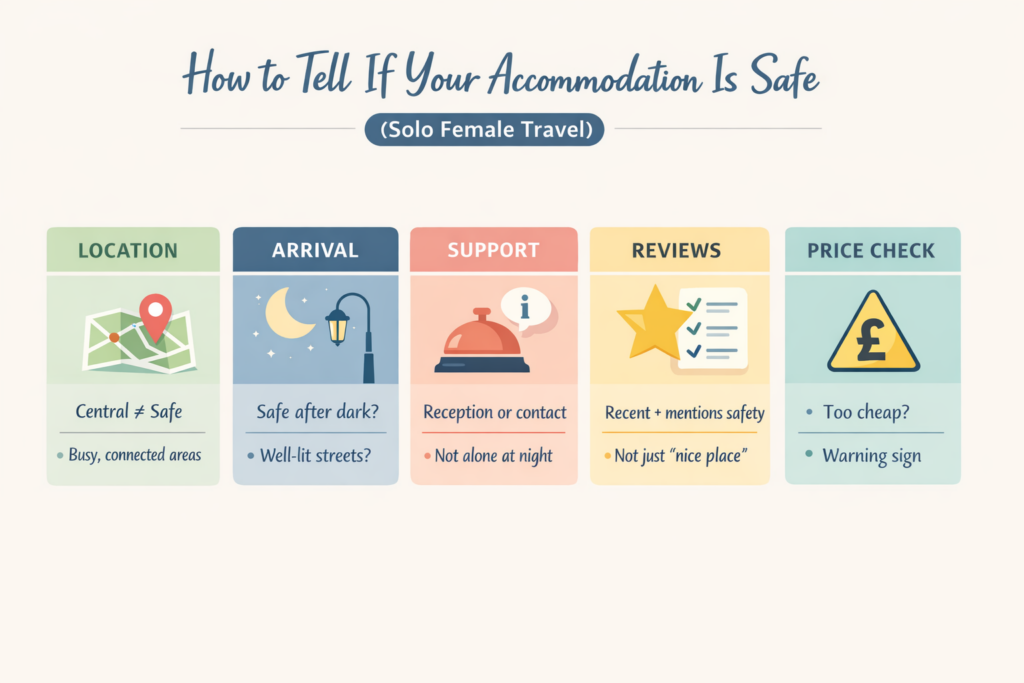
Checklist showing how to identify safe accommodation for solo female travellers in Europe, including location, arrival safety, support, reviews and price warning signs
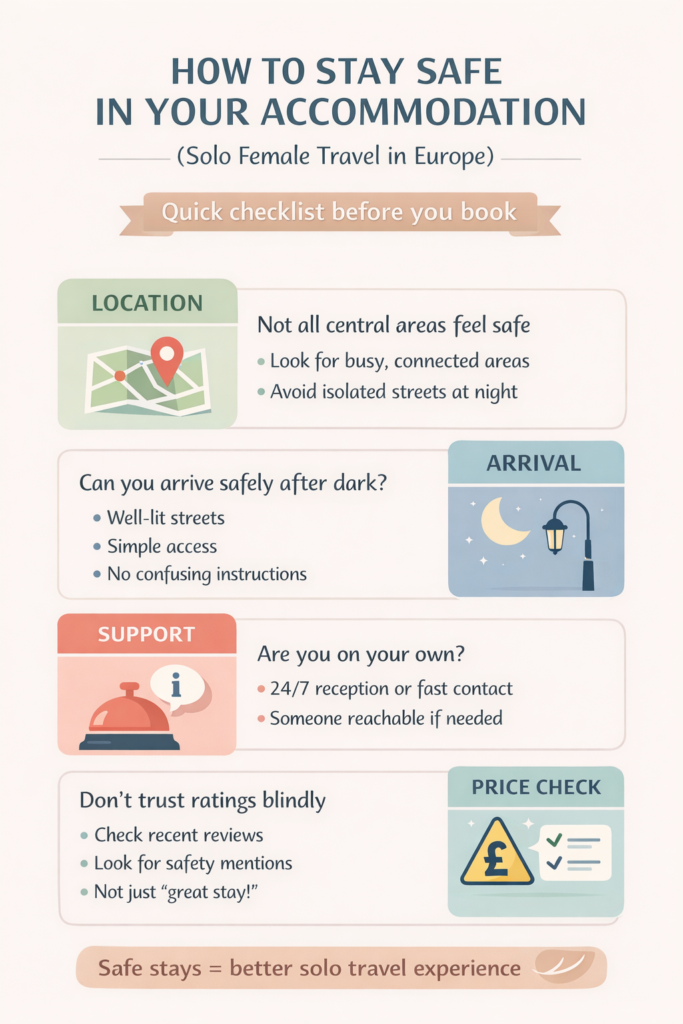
Vertical infographic showing a checklist to choose safe accommodation for solo female travellers in Europe, including location, arrival safety, support, reviews and price warning signs
If in doubt, use this checklist before booking—especially in cities where neighbourhoods can vary widely.
Red flags most solo travellers overlook
- Self check-in with unclear or complicated instructions
- No recent reviews or overly vague descriptions
- Properties located in isolated or poorly lit streets
- Arrivals that require multiple late-night transport changes
It’s also worth checking official travel advice before booking—resources like the UK Foreign Travel Advice can give useful context about safety in specific destinations.
A quick checklist before you book
- Will I feel comfortable arriving here after 9pm?
- Is the area active or completely empty at night?
- Are safety and location mentioned in recent reviews?
- Is transport easily accessible nearby?
- Can I get help quickly if something goes wrong?
Final thoughts
Safe accommodation isn’t about finding the “perfect” place—it’s about reducing uncertainty. And when you’re travelling solo, that peace of mind makes a bigger difference than a slightly cheaper deal or a trendier neighbourhood.
With the right balance between location, practicality and instinct, you’ll not only stay safe—you’ll feel confident exploring wherever you go next.